CAT6 FTP patch cord is suitable for standard Gigabit Ethernet structured cabling projects, while CAT6A FTP patch cord is designed for higher bandwidth, 10Gbps transmission, and better long-distance performance. For project buyers, the key decision depends on required data rate, installation distance, EMI environment, and long-term scalability—CAT6 FTP is cost-efficient for general office networks, while CAT6A FTP is the preferred choice for data centers, high-density enterprise networks, and future-proof infrastructure.
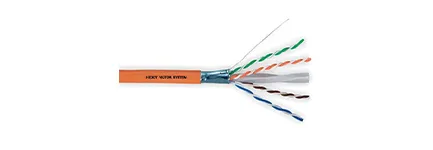
CAT6 FTP and CAT6A FTP patch cords both use foil shielding twisted pair (FTP) construction to reduce electromagnetic interference (EMI), but they differ significantly in performance and engineering standards.
CAT6 FTP patch cord typically supports up to 1Gbps (and short-distance 10Gbps up to ~55m under ideal conditions).
CAT6A FTP patch cord supports stable 10Gbps transmission up to 100m with improved alien crosstalk control.
CAT6A has thicker conductor structure and stricter crosstalk suppression design.
For structured cabling procurement, CAT6 FTP is often used in cost-sensitive office environments, while CAT6A FTP is selected for backbone-intensive or high-performance systems such as data centers and smart buildings.
Feature | CAT6 FTP Patch Cord | CAT6A FTP Patch Cord |
Bandwidth | Up to 250 MHz | Up to 500 MHz |
Transmission Speed | 1Gbps (10Gbps short distance) | 10Gbps stable |
Max Distance | 100m (1Gbps) | 100m (10Gbps) |
Shielding Structure | Foil shielding (FTP) | Enhanced foil shielding + improved isolation |
Crosstalk Control | Moderate | Strong (alien crosstalk optimized) |
Cable Diameter | Smaller, more flexible | Thicker, less flexible |
Cost Level | Lower | Higher |
Typical Use | Office LAN, general networking | Data center, enterprise backbone |
This comparison clearly shows that CAT6A FTP patch cord significantly improves high-speed stability and interference resistance, especially in dense cabling environments.
In real-world engineering projects, theoretical specifications only tell part of the story. The actual performance difference between CAT6 FTP patch cord and CAT6A FTP patch cord becomes more obvious under high-density deployment.
CAT6 FTP is sufficient for standard office applications such as email, ERP systems, and file sharing. However, when network load increases or multiple high-speed devices operate simultaneously, performance may fluctuate.
CAT6A FTP patch cord maintains stable 10Gbps performance even under continuous heavy traffic, making it suitable for virtualization, cloud computing access, and large-scale data transmission.
Both use FTP shielding, but CAT6A FTP introduces stricter pair separation and improved shielding geometry. This significantly reduces alien crosstalk in dense cable trays, especially in industrial environments or server racks.
CAT6 FTP is more of a short-to-mid-term solution. CAT6A FTP is designed for long-term infrastructure planning, reducing future replacement costs when upgrading to 10G networks.
Choosing between CAT6 FTP patch cord and CAT6A FTP patch cord depends on deployment scenario rather than just price.
Small to medium office networks. Standard LAN wiring systems. Budget-sensitive commercial buildings. Short-term IT infrastructure projects
Data centers and server rooms. Smart buildings and intelligent transportation systems. Enterprise backbone networks. High EMI industrial environments. Long-term 10Gbps network planning
For procurement teams, selecting the correct category at the design stage can significantly reduce future upgrade costs and downtime risks.
Before placing bulk orders, project buyers should evaluate the following key factors: Required bandwidth (1Gbps vs 10Gbps). Maximum transmission distance per link. Installation environment (EMI level, cable density). Compatibility with switches, routers, and patch panels. Future scalability requirements (3–5 years planning). Budget allocation per channel. Certification requirements (ISO/IEC, TIA compliance).
For large-scale procurement, it is recommended to standardize cable selection across the project to avoid mixed performance issues.
OEM and bulk customization support is available for engineering contractors and distributors to ensure consistent quality and branding.
Yes, but only under very short distances (typically up to 55 meters under ideal conditions). It is not recommended for stable 10Gbps backbone use.
Not always. CAT6A FTP offers higher performance, but for simple office networks, CAT6 FTP is more cost-effective.
Both use FTP shielding, but CAT6A FTP has enhanced design to better reduce alien crosstalk and improve high-frequency stability.
CAT6A FTP patch cord is the recommended choice for data centers due to its stable 10Gbps performance and stronger interference resistance.
Yes, slightly. CAT6A cables are thicker and less flexible, requiring more careful routing and cable management.
Technically yes, but it is not recommended for structured cabling projects due to performance inconsistency risks.
For short-term, budget-controlled networking projects, CAT6 FTP patch cord is sufficient. However, for enterprise-level infrastructure, data centers, and future-proof 10Gbps planning, CAT6A FTP patch cord is the more strategic investment.
To support your project requirements, HEDOT provides stable manufacturing capacity, OEM customization, and consistent quality control for large-volume orders.
For bulk quotation, technical datasheets, or OEM support, please contact HEDOT to request specifications and project pricing.
 Call us on:
  Email Us:
  No.10 Xumutang Road, Lishui Economic Development Zone, Nanjing, China
 EN
EN
 fr
fr  de
de  es
es  ru
ru  pt
pt  ar
ar  vi
vi  th
th  id
id