
 EN
EN
 fr
fr  de
de  es
es  ru
ru  pt
pt  ar
ar  vi
vi  th
th  id
id 
For telecom networks, campus backbones, FTTH routes, industrial communication systems and long-distance outdoor links, selecting the right outdoor fiber optic cable is not only about fiber count or price. Buyers also need to evaluate cable structure, mechanical strength, water resistance, sheath material, installation method and long-term environmental performance. This is where IEC 60794 becomes an important reference.
IEC 60794 is a series of standards related to optical fibre cables. For outdoor cable buyers, it helps provide a technical framework for understanding cable construction, test methods and performance requirements. This guide explains how IEC 60794 applies to outdoor fiber optic cables, what buyers should check, and how to select suitable cables for aerial, duct and direct-buried applications.
If you need a broader overview of IEC, TIA, ISO/IEC and ITU-T references, you can also read our fiber optic standards guide for cable selection and network projects.
What Is IEC 60794?
IEC 60794 is a standard series for optical fibre cables. In practical cable selection, it is commonly used to understand general cable requirements, construction rules, mechanical performance, environmental testing and application-specific cable specifications.
Compared with standards that focus mainly on the optical fiber itself, IEC 60794 is more useful when buyers need to evaluate the finished cable. For example, an outdoor cable may use standard single-mode fiber inside, but the finished cable also needs proper sheath, strength member, water-blocking structure, armor or aerial support design depending on the installation environment.
| Standard Focus | Main Question It Helps Answer | Buyer Relevance |
|---|---|---|
| Optical fiber performance | What type of fiber is inside the cable? | Helps check attenuation, fiber type and transmission distance. |
| Finished cable structure | Can the cable survive the installation and operating environment? | Helps evaluate tensile strength, crush resistance, sheath design and water protection. |
| Outdoor cable application | Is the cable suitable for aerial, duct or direct-buried installation? | Helps buyers select the correct outdoor fiber optic cable type for the project. |
Why IEC 60794 Matters for Outdoor Fiber Optic Cable Buyers
Outdoor fiber optic cables face more complex conditions than indoor cables. They may be exposed to pulling tension, temperature changes, moisture, soil pressure, UV radiation, wind vibration, rodents, cable ducts or long-distance installation routes. If the cable structure is not suitable, the project may face attenuation increase, fiber damage, water ingress or service interruption.
Using IEC 60794 as a reference helps buyers ask more accurate technical questions before ordering outdoor cables. Instead of only asking for “outdoor cable price,” buyers can check whether the cable structure matches the installation method and project risks.
IEC 60794 Helps Define Mechanical Performance
Outdoor cables may need to withstand pulling force during installation, compression in ducts or soil, bending during routing and long-term mechanical stress. IEC 60794-related test methods help buyers understand mechanical requirements such as tensile performance, crush resistance, bending and cable structure stability.
IEC 60794 Helps Evaluate Environmental Resistance
Outdoor cables may need protection against moisture, temperature variation and environmental aging. For duct and direct-buried applications, water-blocking structure and sheath design are especially important. For aerial applications, cable design must also consider wind, span distance and long-term outdoor exposure.
IEC 60794 Helps Match Cable Type with Installation Method
Not every outdoor cable is suitable for every outdoor project. A duct cable, direct-buried cable and aerial cable may all be used outdoors, but their structures are different. IEC 60794 helps buyers think in terms of application-specific requirements rather than using one general cable for all environments.
IEC 60794 and Common Outdoor Fiber Optic Cable Applications
For B2B procurement, the most important question is not only “Does this cable meet IEC 60794?” but also “Which outdoor cable structure is suitable for this project?” The following table summarizes common outdoor installation scenarios.
| Application Scenario | Typical Cable Requirement | What Buyers Should Check | Suggested HDC Product Direction |
|---|---|---|---|
| Aerial installation | Self-supporting or lashed aerial cable structure | Tensile strength, span distance, wind vibration, sheath durability and installation tension | Outdoor fiber optic cables |
| Duct installation | Cable suitable for pulling or blowing through ducts | Pulling tension, outer sheath friction, bending radius, water-blocking design and duct route length | Outdoor duct fiber optic cables |
| Direct-buried installation | Reinforced cable with mechanical and moisture protection | Crush resistance, water penetration, armor structure, sheath thickness and soil pressure | GYFTA53 inner sheath cable |
| Indoor-outdoor transition | Cable suitable for both outside plant and premises environments | Outdoor durability, indoor flame or low-smoke requirements and routing conditions | Indoor fiber optic cables and outdoor cable solutions |
| Campus or telecom backbone | Long-distance stable optical transmission cable | Fiber type, cable route, water-blocking performance, tensile strength and termination plan | Single-mode outdoor fiber optic cable |
IEC 60794 for Duct and Direct-Buried Outdoor Fiber Optic Cables
Duct and direct-buried installations are two common outdoor cable applications. IEC 60794-3-10 is especially relevant because it covers optical telecommunication cables used in ducts or direct-buried applications, and such cables may also be used for lashed aerial applications according to the IEC Webstore description.
For duct installation, the cable may be pulled or blown through a conduit. Buyers should pay attention to outer sheath smoothness, cable diameter, tensile strength, bending radius and water-blocking performance. If the duct route is long or complex, installation tension and cable flexibility become especially important.
For direct-buried installation, the cable is exposed to greater mechanical and environmental stress. It may need stronger sheath, armor, water-blocking tape, filling compound or an inner sheath structure to protect the cable core from soil pressure and moisture. For these projects, a reinforced product such as GYFTA53 inner sheath cable can be considered when the route requires stronger outdoor protection.
IEC 60794 for Aerial Outdoor Fiber Optic Cables
Aerial fiber optic cables face different risks from duct or direct-buried cables. They may be exposed to wind, vibration, span tension, temperature changes and long-term outdoor weathering. For self-supporting aerial cables such as ADSS cables, mechanical design is a key selection factor.
IEC 60794 includes test methods related to aerial cable mechanical performance. For example, IEC 60794-1-119 defines test procedures for mechanical performance requirements related to aeolian vibrations and applies to aerial optical fibre cables such as ADSS, OPGW and OPPC cables according to the IEC Webstore description.
When selecting aerial outdoor fiber optic cables, buyers should check the following factors:
Span distance and installation tension
Strength member type
Wind vibration and long-term cable movement
Outer sheath material and UV resistance
Fiber count and cable diameter
Installation method and hardware compatibility
For outdoor aerial network projects, buyers can explore HDC outdoor fiber optic cables and confirm the proper cable structure according to route length, pole span, environmental conditions and mechanical requirements.
Key Performance Items Buyers Should Check Under IEC 60794
Different projects may require different test items, but the following performance factors are commonly important when buyers evaluate outdoor fiber optic cables.
| Performance Item | Why It Matters | Typical Buyer Question |
|---|---|---|
| Tensile strength | Helps ensure the cable can handle pulling force during installation. | Can the cable withstand the required installation tension? |
| Crush resistance | Important for duct, direct-buried and mechanically exposed environments. | Can the cable core remain protected under pressure? |
| Bending performance | Affects routing flexibility and fiber safety during installation. | What is the minimum bending radius during and after installation? |
| Water penetration | Critical for outdoor, duct and direct-buried cables. | Does the cable include water-blocking tape, filling compound or other moisture protection? |
| Temperature performance | Outdoor cables may face hot, cold or changing environments. | Can the cable maintain stable performance across the project temperature range? |
| Sheath structure | Protects the cable from moisture, abrasion, UV and mechanical stress. | Is the sheath suitable for outdoor, duct, aerial or direct-buried use? |
How to Choose Outdoor Fiber Optic Cables Based on IEC 60794
Before choosing an outdoor cable, buyers should first define the project environment. Then they can match the cable structure with the required performance items. The following checklist can help B2B buyers and project engineers prepare a more accurate inquiry.
| Selection Step | What to Confirm | Recommended Action |
|---|---|---|
| 1. Confirm installation method | Aerial, duct, direct-buried, indoor-outdoor transition or campus backbone | Choose the cable family before comparing price. |
| 2. Confirm mechanical stress | Pulling tension, crush risk, bending radius and installation route | Ask for tensile, crush and bending performance information. |
| 3. Confirm moisture exposure | Duct water, soil moisture, outdoor humidity or underground route | Check water-blocking design and sheath structure. |
| 4. Confirm fiber type | Single-mode, multimode, G.652, G.657 or project-specific fiber | Match fiber type with transmission distance and routing conditions. |
| 5. Confirm sheath and armor | PE sheath, inner sheath, aluminum tape, steel tape or non-metallic strength member | Select protection structure according to outdoor risks. |
| 6. Confirm testing and documentation | Factory test report, attenuation data, mechanical requirement and project specification | Request technical documents before bulk procurement. |
Outdoor Cable Structure: What Buyers Should Understand
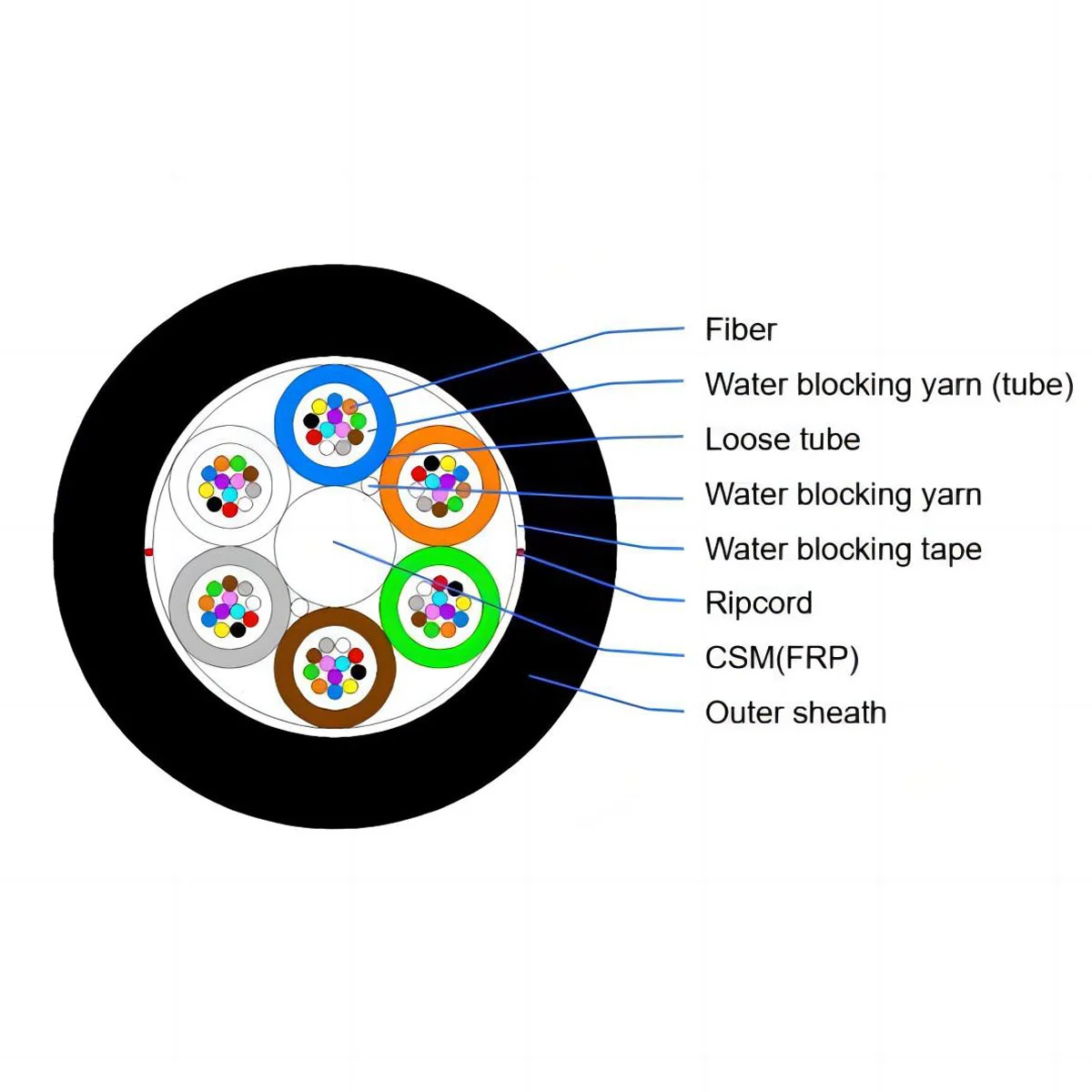
Outdoor fiber optic cable performance depends on the complete cable structure, not only the optical fiber inside. A typical outdoor cable may include optical fibers, loose tubes, filling compound, water-blocking tape, strength members, inner sheath, armor and outer sheath. Different structures are used for different environments.
For example, duct cables may need good pulling performance and water resistance. Direct-buried cables may need reinforced armor and stronger crush resistance. Aerial cables may need self-supporting strength members and stable mechanical performance under wind and tension.
If your project requires reinforced outdoor or underground protection, it is also useful to understand the role of the inner sheath in cable. The inner sheath can help protect the cable core, improve structural stability and reduce stress from outer protective layers.
Common Mistakes When Buying Outdoor Fiber Optic Cables
Many cable procurement problems happen because buyers compare outdoor cables only by price or fiber count. For outdoor projects, this can lead to product mismatch and installation failure.
| Common Mistake | Possible Risk | Better Practice |
|---|---|---|
| Using one outdoor cable type for all routes | The cable may not fit aerial, duct and direct-buried environments equally well. | Select cable structure based on installation method. |
| Ignoring water-blocking design | Moisture may enter the cable and affect long-term reliability. | Check water penetration resistance and moisture protection materials. |
| Only comparing fiber count | Same fiber count can have very different cable structures and protection levels. | Compare sheath, strength member, armor and mechanical performance. |
| Not confirming pulling tension | Cable may be damaged during installation. | Check tensile strength and installation route requirements. |
| Ignoring termination and accessories | The cable may not match the planned patch panel, closure or cabinet design. | Plan cable, accessories and testing as one system. |
Recommended HDC Outdoor Fiber Optic Cable Solutions
HDC provides outdoor fiber optic cable options for different network environments, including aerial, duct, direct-buried and reinforced cable applications. Buyers can select the cable family according to installation method, environmental stress and required optical performance.
| Project Type | Recommended Product Direction | Why It Fits |
|---|---|---|
| General outdoor telecom route | Outdoor fiber optic cables | Suitable for outside plant communication networks and long-distance outdoor routes. |
| Duct installation | Outdoor duct fiber optic cable | Designed for installation through ducts with attention to pulling, bending and moisture resistance. |
| Direct-buried installation | GYFTA53 inner sheath cable | Reinforced structure helps protect the cable core in demanding outdoor or underground environments. |
| Indoor-outdoor transition | Indoor fiber optic cables and outdoor cable solutions | Useful when the route needs both outdoor durability and indoor wiring compatibility. |
Need Help Selecting IEC 60794 Outdoor Fiber Optic Cables?
When selecting outdoor fiber optic cables, buyers should share the installation method, route length, pulling condition, moisture exposure, fiber type, required fiber count and project standard requirements. This helps the supplier recommend the correct cable structure rather than a generic outdoor cable.
HDC can help buyers choose suitable outdoor fiber optic cables for aerial, duct, direct-buried, campus backbone and telecom network projects. If you are preparing a project inquiry, provide your cable route and installation environment so our team can recommend a suitable cable structure and product option.
Contact HDC for outdoor fiber optic cable selection support
FAQ About IEC 60794 and Outdoor Fiber Optic Cables
What is IEC 60794 used for?
IEC 60794 is used for optical fibre cables. For outdoor cable buyers, it helps provide a reference for cable construction, performance requirements, mechanical testing, environmental resistance and application-specific cable selection.
Is IEC 60794 relevant to outdoor fiber optic cables?
Yes. IEC 60794 is highly relevant to outdoor fiber optic cables because outdoor cables must be evaluated not only by optical performance but also by tensile strength, crush resistance, water-blocking design, bending performance, sheath structure and environmental durability.
What is the difference between duct cable and direct-buried cable?
A duct cable is installed inside a conduit or duct and must handle pulling, bending and possible moisture inside the duct. A direct-buried cable is installed underground without a protective duct, so it usually needs stronger mechanical protection, moisture resistance and sometimes armor or reinforced sheath structure.
Which IEC 60794 standard applies to duct and direct-buried cables?
IEC 60794-3-10 is relevant to optical telecommunication cables used in ducts or direct-buried applications. It may also apply to cables used for lashed aerial applications according to the IEC Webstore description.
What should buyers check before ordering outdoor fiber optic cables?
Buyers should check installation method, fiber type, fiber count, cable diameter, tensile strength, crush resistance, bending radius, water-blocking structure, sheath material, armor design and project testing requirements before ordering outdoor fiber optic cables.
Does every outdoor cable need armor?
No. Not every outdoor cable needs armor. Aerial, duct and direct-buried projects have different mechanical risks. Armor is more commonly considered when the cable faces soil pressure, rodent risk, mechanical impact or underground installation conditions.
How can IEC 60794 help reduce project risk?
IEC 60794 helps buyers evaluate whether a cable structure is suitable for the intended environment. By checking mechanical, environmental and structural requirements before procurement, buyers can reduce installation damage, moisture-related failures and long-term network reliability issues.

 Call us on:
  Email Us:
  No.10 Xumutang Road, Lishui Economic Development Zone, Nanjing, China