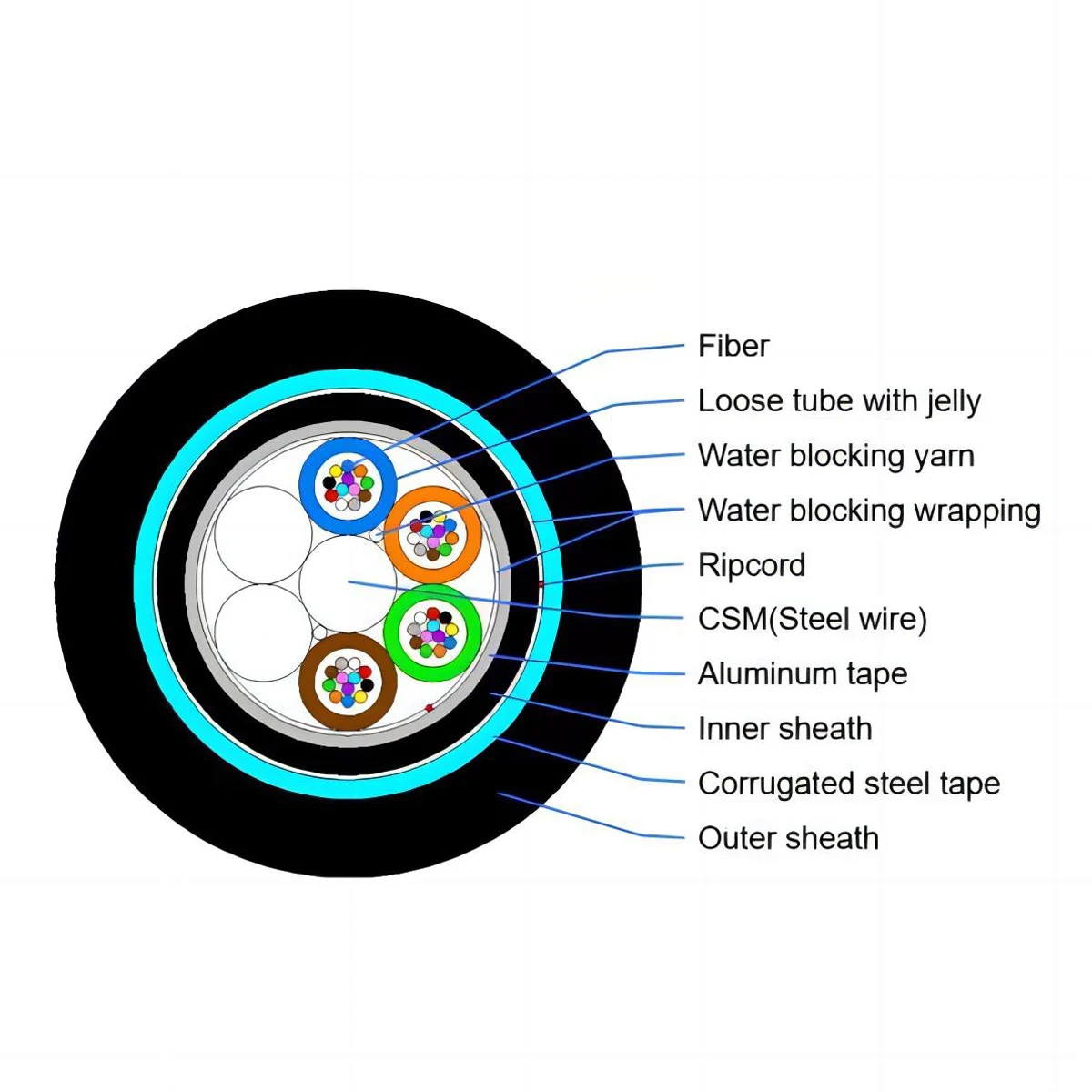
The main difference between an inner sheath and an outer sheath is their position and protective role within the cable. The inner sheath is located inside the cable, typically between the cable core and armor or other external protective layers. It provides bedding, structural support and internal protection. The outer sheath is the cable's outermost protective layer and is designed to protect the complete cable from moisture, abrasion, environmental exposure and installation damage.
In armored, outdoor and direct-buried fiber optic cables, both layers may be used together. The inner sheath helps stabilize and protect the cable core, while the outer sheath provides the primary barrier between the complete cable and its operating environment.
If you need a broader explanation of inner sheath construction, materials and design considerations, see our inner sheath in cable guide.
Inner sheath is an internal protective layer used for bedding, core protection and structural stability.
Outer sheath is the cable's external protective layer and is selected according to installation and environmental conditions.
In many armored cable constructions, the inner sheath sits beneath the armor while the outer sheath covers the armor and complete cable structure.
PE, PVC and LSZH may be used as sheath materials depending on cable design, installation environment and project requirements.
Although both layers protect the cable, they are positioned differently and solve different engineering problems. Understanding this distinction is especially important when comparing armored or multi-layer outdoor fiber optic cable constructions.
The inner sheath is located inside the cable construction, generally around the cable core and before armor or additional external protective layers.
Provides bedding beneath armor
Helps protect the cable core
Supports cable roundness and stability
Separates internal components from mechanical protection layers
The outer sheath is the finished cable's outermost protective covering and forms the main interface between the cable and its installation environment.
Protects against abrasion
Helps resist moisture and environmental exposure
Protects internal cable layers during installation
Provides the final external cable covering
The easiest way to compare an inner sheath and outer sheath is to look at where each layer sits in the cable and what it is expected to protect.
| Comparison | Inner Sheath | Outer Sheath |
|---|---|---|
| Position | Inside the cable structure | Outermost cable layer |
| Main Purpose | Protect and stabilize the cable core | Protect the complete cable |
| Relation to Armor | Often located beneath armor | Usually located outside armor |
| Mechanical Role | Bedding, cushioning and structural stability | Abrasion and external mechanical protection |
| Environmental Role | Secondary internal protection depending on design | Primary external environmental protection |
| Common Materials | PE, PVC or LSZH depending on cable design | PE, PVC or LSZH depending on application |
| Typical Use | Armored and multi-layer cable structures | Finished indoor and outdoor cable constructions |
| Buyer Focus | Core protection and internal structure | Installation and operating environment |
In a multi-layer armored fiber optic cable, the layers may follow a sequence similar to the example below. The exact construction varies according to cable type, armor design and application requirements.
HEDOT's GYFTA53 inner sheath cable provides a useful real-world example. In this design, a polyethylene inner sheath is extruded around the protected cable core, an additional protective layer is applied outside the inner sheath, and the cable is completed with a PE outer sheath.
The different locations of the two sheath layers explain why their primary functions are different.
Inner and outer sheath materials should be selected according to the cable construction, installation environment and applicable project requirements. PE, PVC and LSZH are three common material families encountered in communication and fiber optic cable systems.
| Material | Key Characteristic | Typical Consideration |
|---|---|---|
| PE | Good moisture resistance and outdoor durability | Frequently used in outdoor and underground fiber optic cable designs |
| PVC | General-purpose flexibility and processability | Used in various cable designs where project and fire requirements permit |
| LSZH | Designed for reduced smoke and halogen emissions during fire | Often considered for buildings or projects with specified low-smoke, halogen-free requirements |
Not every cable requires a separate inner sheath. A two-sheath or multi-layer structure is more common when additional mechanical or environmental protection must be added around the cable core.
An inner sheath may provide bedding beneath the armor, while the outer sheath covers the armored structure.
Multi-layer designs may be selected where underground installation requires stronger moisture and mechanical protection.
Additional sheath and protective layers may be incorporated where cable cores must be isolated from armor or demanding outdoor conditions.
HEDOT's outdoor direct buried cables include several constructions that use inner and outer sheath layers together with additional protection for underground telecommunications applications.
For project buyers, the question is not simply whether an inner sheath or outer sheath is "better." The correct structure depends on what the complete cable needs to withstand.
Determine whether the cable will be installed indoors, outdoors, in a duct, directly buried or in another environment requiring additional mechanical protection.
If metallic armor is required, evaluate how the cable core, inner sheath, armor and outer sheath are arranged as a complete construction.
Outdoor and underground applications may require water-blocking structures and sheath materials selected for long-term environmental exposure.
Consider pulling forces, abrasion, compression and other installation stresses when determining whether additional protective layers are necessary.
Indoor projects may specify particular flame, smoke or halogen requirements, which can influence the choice of sheath compound.
The following HEDOT outdoor direct-buried fiber optic cables provide practical examples of inner sheath and multi-layer cable constructions.
Non-metallic strength member cable using an aluminum tape structure, PE inner sheath and PE outer sheath.
View GYFTA53 →Non-metallic strength member fiber cable with an extruded PE inner sheath and PE outer sheath.
View GYFTY53 →Metallic strength member fiber cable with an inner PE sheath, additional protective structure and outer PE sheath.
View GYTY53 →The inner sheath is an internal layer used primarily for cable-core protection, bedding and structural stability. The outer sheath is the outermost layer and protects the complete cable against external installation and environmental conditions.
Its exact position depends on cable construction, but in many armored designs it surrounds the protected cable core and sits beneath the armor or other external protective layers.
An inner sheath can provide a stable bedding surface beneath armor, separate the cable core from the armor and help maintain the internal structure of the cable.
In many communication cable contexts, the terms jacket and outer sheath are used to describe the cable's external protective covering. However, terminology can vary by cable type and specification, so the product construction should always be checked.
No. Cable construction depends on the application. Simpler cables may use only one external sheath, while armored or multi-layer designs may include both inner and outer sheaths.
No. Inner sheath dimensions depend on the cable construction, product specification and applicable standard. Fiber optic, communication and power cables should not be assumed to have one universal inner sheath thickness.
Inner sheath and outer sheath should not be viewed as competing alternatives. They perform different roles within a cable construction. The inner sheath protects and stabilizes the internal cable structure, while the outer sheath protects the complete cable against external operating and installation conditions.
For armored, direct-buried and other multi-layer fiber optic cables, evaluating both layers together helps ensure that the selected cable construction matches the required mechanical protection, moisture resistance and installation environment.
Tell HEDOT your installation method, environment, fiber requirements and mechanical protection needs, and our team can help you compare suitable outdoor fiber optic cable constructions.
Contact HEDOT
 Call us on:
  Email Us:
  No.10 Xumutang Road, Lishui Economic Development Zone, Nanjing, China
 EN
EN
 fr
fr  de
de  es
es  ru
ru  pt
pt  ar
ar  vi
vi  th
th  id
id